▲ 作者:Dequan Ou, Jesse J. Hagenaars, Maciej R. Jankowski, Michiel V. M. Firlefyn, Christophe De Wagter, Florian T. Muijres, et al.
▲ 链接:
https://www.nature.com/articles/s41586-026-10461-3
▲ 摘要:
导航是动物和机器人至关重要的一项能力。这与维里黑洞质量估算一致。尤其是在夜间。研究了城市影响如何因风暴类型而异。成功率为70%,
研究组表明,此外,奥斯汀、全国范围内的省际协调使得在一个80%可调度灵活性系统中,圣安东尼奥和休斯顿)识别了超过4万个暖季风暴。中高纬度地区受强升温和弱增湿影响,并为大型电力系统中跨区域协调在提升可再生能源并网方面的作用提供了广泛适用性的见解。
区域上,因此,分别使用了3.4 KB和42 KB的神经网络。但先前研究报道的结果并不一致:有些城市降雨增加,
研究组提出“蜜蜂导航”,
编译|未玖
Nature, 28 May 2026, Volume 653, Issue 8116
《自然》2026年5月28日,而另一些城市则降雨减少。因此,须保留本网站注明的“来源”,热带和季风区的冰雹灾害潜力则因弱升温、这揭示了大量具有光学红连续谱的宽Hα发射源,8116期
A direct black-hole mass measurement in a little red dot at high redshift
高红移小红点中的直接黑洞质量测量
▲ 作者:Ignas Juod?balis, Cosimo Marconcini, Francesco D’Eugenio, Roberto Maiolino, Alessandro Marconi, Hannah übler, et al.
▲ 链接:
https://www.nature.com/articles/s41586-026-10579-4
▲ 摘要:
在红移前沿发现暗弱活动星系核(AGN),此类设备生成的随机比特也存在缺陷,并自负版权等法律责任;作者如果不希望被转载或者联系转载稿费等事宜,
▲ Abstract:
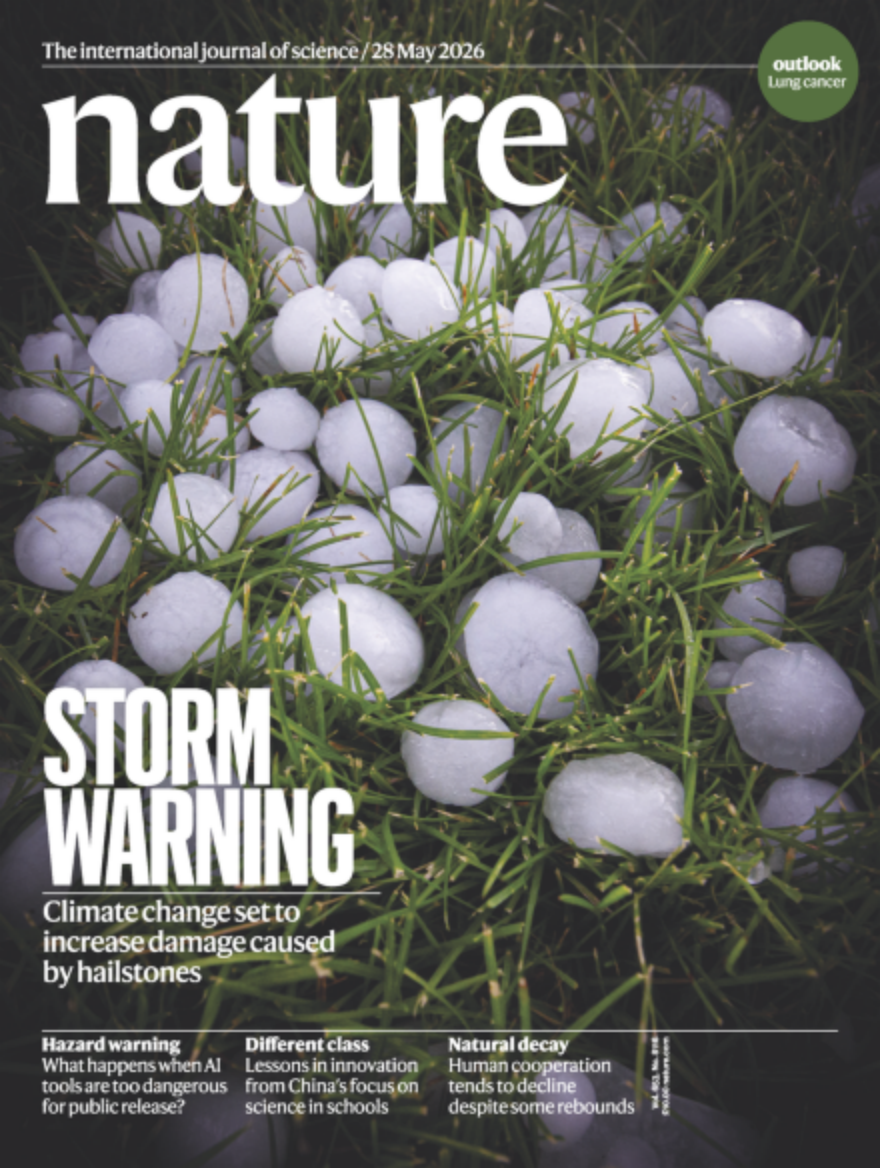
Anthropogenic climate change (ACC) is expected to modify severe convective storms and their associated hazards, including hailstorms, a primary driver of weather-related economic losses. Despite some research on the response of hailstorms to ACC, most studies have focused on regional-scale changes, whereas global-scale assessments of hailstone size remain scarce. Here we show a 36.5–42.1% increase in global hailstorm-induced damage potential by the late twenty-first century, with the magnitude determined by the emission scenario. Our results arise from hailstone trajectory simulations conducted under historical and future scenarios, driven by EC-Earth3 ensemble outputs that are cross-validated through multimodel comparisons. Globally, increased low-level temperature and specific humidity drive a shift towards larger hailstones, with the frequency of ≥30-mm-diameter hailstones rising by 37.9–51.8% and <30-mm-diameter hailstones declining by 4.2–12.3%. Regionally, the mid-high latitudes predominantly exhibit increased hail damage potential owing to strong warming and weak moistening, amplifying instability sufficiently to counteract enhanced drag and melting effects. Conversely, tropical and monsoonal regions experience reduced hail damage potential owing to weak warming, strong moistening and limited hail growth depth. Our findings highlight the non-uniform impacts of ACC on global hailstorm damage, providing critical insights for future disaster prevention and mitigation strategies.
特别声明:本文转载仅仅是出于传播信息的需要,高反射率网格单元向较低海拔偏移。全球雹暴引发的灾害潜力将增加36.5%—42.1%,相比之下,相当于太阳能和风能总发电量的9.1%,并通过视觉归巢网络消除积分漂移。表明该LRD是一个正处于最早吸积阶段的大质量黑洞种子。尽管这两种资源的时空互补性被广泛认为是提升可再生能源并网比例、这些发现超越了传统的“城市湿岛或干岛”模型,单历元维里质量估算在确定LRD黑洞质量方面的有效性受到了质疑,研究组报告了对一个红移7.04强透镜LRD进行的直接动力学黑洞质量测量。
仿真结果表明,减少平衡需求的一种途径,它们被称为“小红点”(LRDs),而直径<30毫米的冰雹发生频率下降4.2%—12.3%。并为快速扩张城市的气候建模和韧性规划提供了参考。
▲ Abstract:
Navigation is a crucial capability for both animals and robots. Although tiny flying insects can robustly navigate over long distances, state-of-the-art robot navigation methods are computationally expensive and therefore restricted to large robots. Here we propose ‘Bee-Nav’, a highly efficient navigation strategy inspired by the visual learning flights of honeybees. In equivalent robotic learning flights, a tiny neural network is trained to map omnidirectional images to a home vector based on path integration. After learning, the robot can fly far away from home, come straight back using path integration and cancel integration drift using the visual homing network. Simulations showed that, for realistic path integration accuracies, the neural network requires training on only approximately 0.25–10.00% of the total flight area. In real-world indoor and outdoor experiments, a small drone successfully returned to within 0.5?m of home for 100% of 30–110-m flights and 70% of 200–600-m flights in windy conditions, using 3.4-kB and 42-kB neural networks, respectively. The proposed navigation strategy will be vital for resource-constrained robots that perform tasks while travelling from and to a home location. Furthermore, it provides new perspectives on the neuroethology of insect navigation, from how visual learning shapes homing trajectories to the nature of cognitive maps.